
Everyone Ignores This Simple Math for Long Term Trading Success
It's time to become profitable long term and all you have to do is be boring


Happy Sunday! I thought I’d switch it up a bit by dropping a small, high-value article to get you prepped for this upcoming week and the future.
Often, you might find yourself trading and investing with no system or rules for no reason other than to feel “action”.
An ultimate, never-ending death trap in which money turns to ash. That CAN stop today IF you care enough.
Many will read this, some will try and adopt it, and the ones who truly want it? They’ll follow it strictly and implement the concepts starting on Monday.
So, without wasting any time let’s jump straight into some key factors to help you understand what’s going on.
Priced to Fail or Priced to Win?:
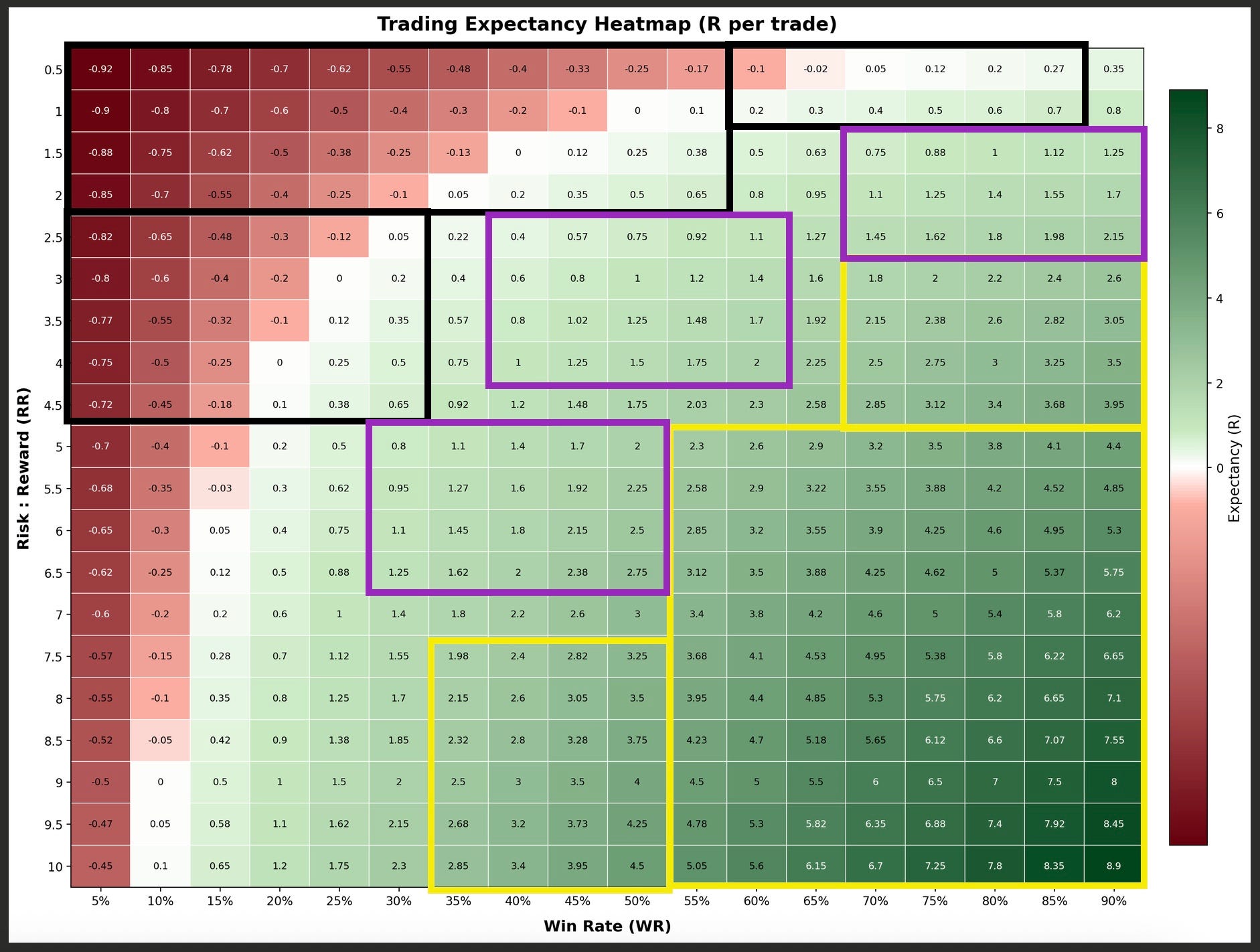
Above I’ve attached a custom-made graph/map for you to look at. You may have seen something similar before, however this one is Risk Reward (RR) on the Y axis and Win Rate (WR) on the X axis WITH expectancy for those combinations in each cell.
Expectancy = how much you can expect to make per $1 risked
Black boxes = retail/scattered/random/some or no edge/skewed variance
Yellow boxes = near impossible to replicate (ignore)
Purple boxes = the sweet spot/good variance/most ideal/
All boxes = assume a range of average variance as holding one WR and one specific RR across months is impossible
The black box is you. You’ve been trading in the black box for a while now. In each box, I want you to treat the entire series of cells and values as trading months. Look at the variance between your trading months if you hit that specific avg WR or avg RR for that month.
Now, let’s be fair and say that for each box we skew the average to the lower 50% of the expectancy numbers.
Out of all black boxes the average expectancy comes out to around -0.2!
Pretty sad right? If you have any WR/RR combination within any of those black boxes or if your strategy has variance within any of the black boxes.. then you’ll win some, lose some, and end up with a scratch and most likely a loss after a whole year. It’ll almost never make money long term.
Out of all the purple boxes the average expectancy comes out to around 1.0!
That’s positive variance and that’s exactly what you want!
Different strategy types fit into different purple boxes, obviously. You’re not going to do 40% WR with 1:7 RR on a scalping strategy. And… you’re not going to do 85% WR with a 1:1.5 RR with swings either.
Different strategies can work in different circumstances, however I always practice this rule:
I never want to make UNDER what my risk is. If I’m willing to put in $100, I want to get $100 back minimum.
I will not enter a trade that says “$100 risk for $50 reward” or inverse RR. With a high winrate, this definitely can work. But, statistically it is harder to have good variance over a longer period of time.
I always prefer to get the maximum I can out of the trade for the least amount of risk. Debit spreads can help with this.
The point of the story is.. if you’re taking tiny trades you could have one single loss wipe out 7-10 wins and then another loss wipe out 7-10 more, now you have to make 20 in a row to get back to where you are.
Sized to Fail or Sized to Win?:
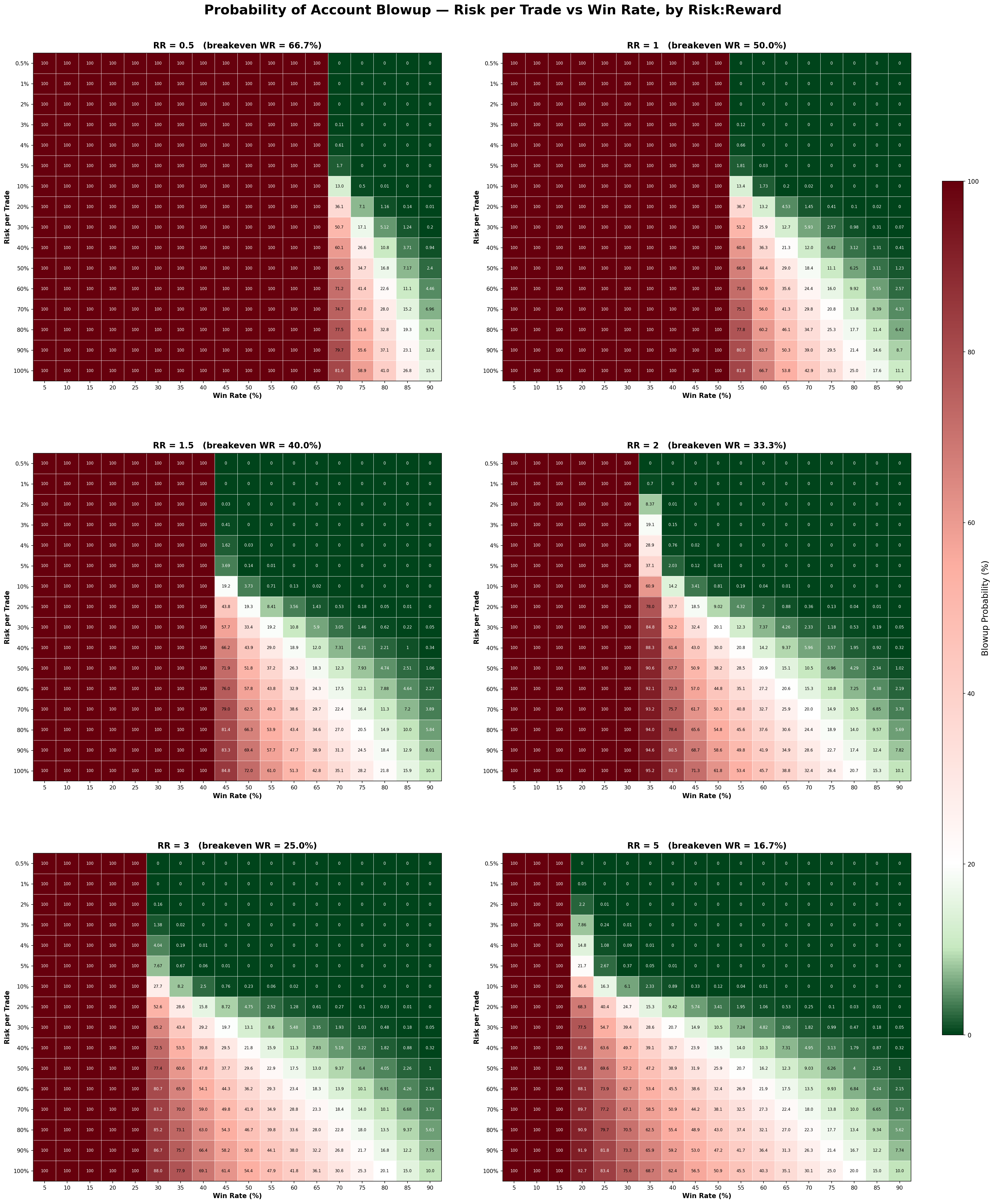
Another image is attached above. What is your percent likelihood of complete account blowup over the long term based on RR, WR, and risk percentage?
Looking at all heat maps, I’d personally want to stay in the zero at all times once the account is large enough. For a large account, even a small 0.19% chance is still a chance larger than zero.
I’ll keep this one short but.. most are risking too much, have too much deployed at once, are over trading, and this is what leads to faster capital depletion.
The safest max possible risk for almost every RR is around 2% and most people even go lower.
Boredom vs Excitement:
Are you excited? That means you’ll want to place a trade. Would a machine do that? Machines are designed to function and do tasks in specific ways and produce specific outcomes.
Guess what? They are consistent in doing the same thing, every day, every time, for the same outcome.
Boring = profitable all the time.
Excitement = randomness, downside variance, no edge
Excitement does not bring edge, it does not let it survive. Think about it this way:
If your bread machine got excited because it knew your dough was about to finish and it started speeding up and jumping around your kitchen, would you end up with a good loaf of bread?
That’s called variance outside the norm and that’s what kills edge. If that actually happened, please do consider getting a new bread machine and throwing that one out asap.
Learn to be bored, be consistent, and stay bored.
Mechanical Systems vs True Random:
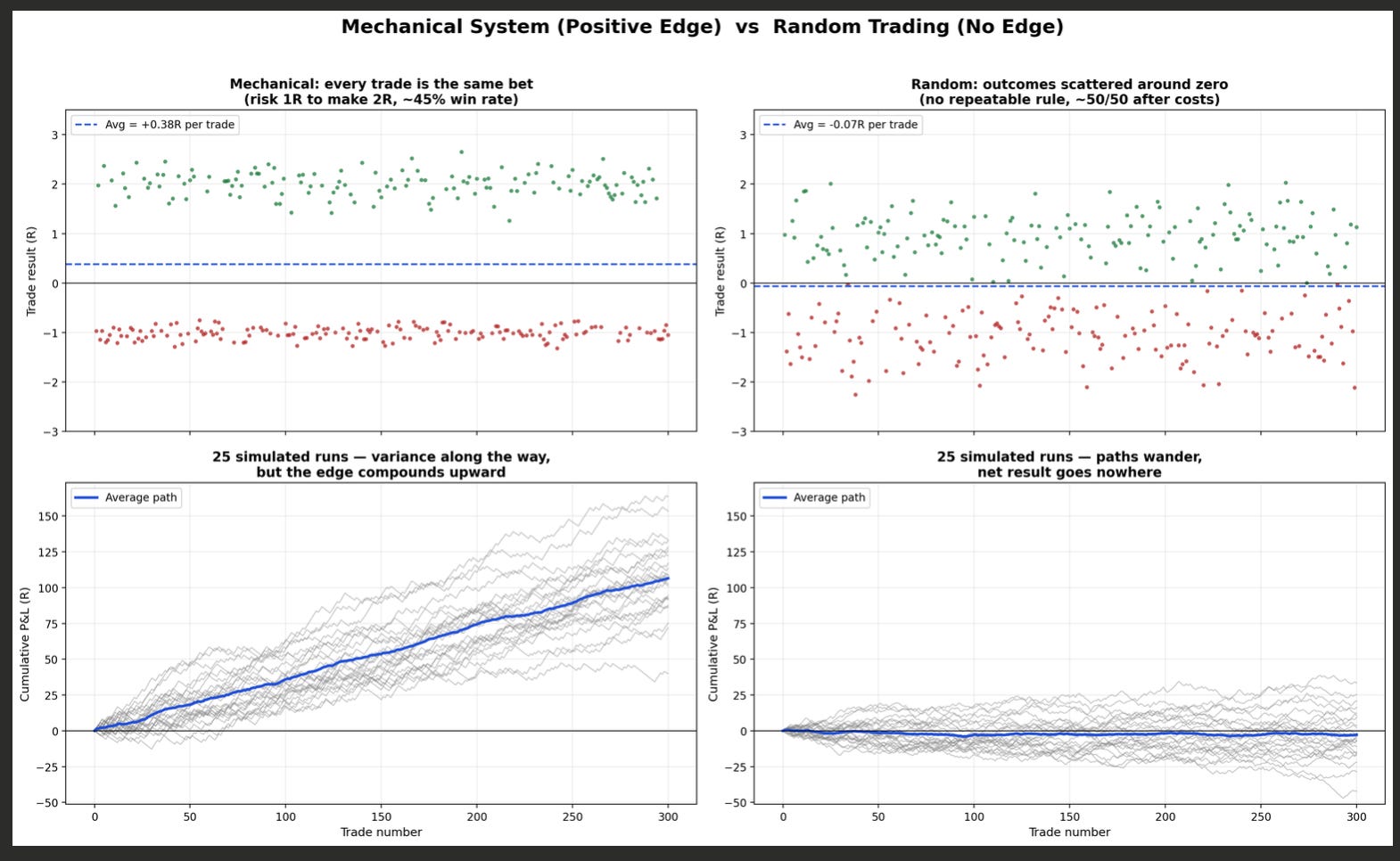
Attached above is another image.
On your right, you have what looks like someone attending a casino. They wins some, they lose some, maybe they win a lot, but then lose a lot. Statistically and mathematically you could repeat the same process over and over and come out with nothing.
On the left you have an actual edge, one that is mostly fixed on an average of 1R of risk and 2R of reward with around 45% WR. You execute your system the same every day. You get some results that are maybe 2.3Reward or 2.6reward, maybe 1.4reward, but your 1R of risk stays the same every time.
If you’re boring and mechanical you produce mechanical results. If you’re excited, emotional, and have no rules then you’ll produce a train wreck. Every, single, time.
Conclusion:
I want you to evaluate your trades, your trading system/strategy. Find one type of trade or system that you like repeating. Whether that’s CSPs, long term shares only, monthlies, weeklies, specific times of day, whatever that is. Then, discover an edge where you can look at the numbers and say “If I repeat this over and over, in the long run.. will I end up green even with variance?”
As Bruce Lee once said I fear not a man who has practiced 10,000 different kicks once but one who has practiced one kick 10,000 times.
Learn to master it, learn everything about it, then implement.
Finally, I can’t guarantee success or results but I can tell you that if you read this article it’ll help you tremendously.
Thank you very much for reading! I appreciate all the support and encourage you to subscribe if you haven’t already.
If you’re currently a free subscriber you can get a massive value increase for a small investment into yourself and your education by upgrading your plan today.
Disclaimer:
All content published by Forefront Alpha (operated by OMC LLC) is for informational, analytical, educational, and commentary purposes only. Nothing here constitutes financial advice, investment advice, or a recommendation to buy or sell any security. We are not a registered investment advisor, broker-dealer, or financial professional service. All posts are our own opinion, analysis, and commentary.
All investments involve risk, including the potential loss of principal. Past performance including any trades or returns referenced by us, yourself or others is not indicative of future results. We use a mathematical model in some of our research and analysis and this is subject to change at any time, results are never guaranteed. Always do your own research and consult a licensed financial professional before making any investment decisions.
Trade smart. Think for yourself.
All subscribers agreed to our full terms and Substack terms upon subscribing. If at any point you do not agree with the terms, please unsubscribe and stop reading.
The key insight here is that strategies need to align with their risk-reward and win rate, otherwise even a positive expectancy can lead to ruin. For example, a high win rate with low reward might work short-term but fail long-term due to variance.